Bullying at the Prince's school
Bullet TrainBullying at the Prince's school is not merely a series of attacks between students: it is a system of control that reaches from the Prince's commands to the teachers’ inaction and the pupils’ fear of one another. Electric shocks and threatened punishment make obedience seem safer than resistance, while the Prince’s calculated influence over adults helps preserve the conditions in which the bullying continues.
A school governed by fear
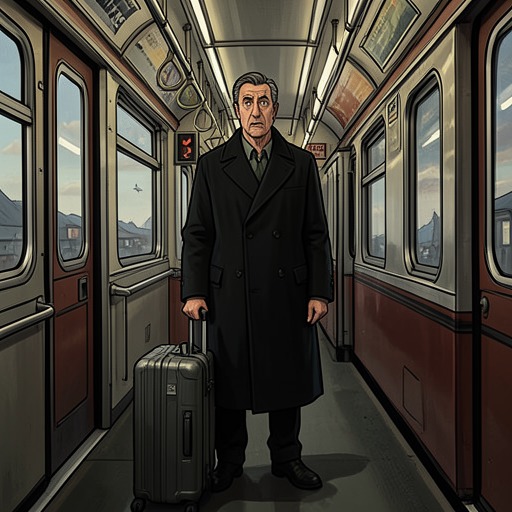
Kimura first glimpses the system in a station men’s room, where five students are trying to decide who will explain a failure to the Prince. Their conversation turns to punishment by electric shock; one says he could barely endure the previous shock and fears that a stronger one could kill him. Kimura cannot yet tell what the Prince has ordered or how the shocks are administered, but he recognizes that the students are not treating the danger as a casual exaggeration. Their fear gives the Prince’s authority a reach beyond his immediate presence.
The students’ anxiety is also social. They argue over who failed to act and who will take responsibility, rather than discussing how to challenge the person giving the orders. When Kimura later urges them to consider opposing the Prince, their reaction makes clear that overthrowing him has not seemed like a possible course of action. Their silence and alarm suggest how thoroughly the limits of their world have been set by his power.
The Prince’s control of the adults
The Prince’s approach rests on the teachers’ expected role as guarantors of order. Students and parents assume that teachers will maintain discipline, much as people may expect the United States or the United Nations to intervene in a crisis. The Prince sees that trust as a vulnerability: if he can control the teachers’ response, he can make life miserable for the students while weakening the ordinary protection they expect from school.
His model comes from reading about Rwanda, including mass killing at a technical school. He maps the analogy onto his own school: widespread violent bullying stands in for genocide, and teachers stand in for outside powers reluctant to acknowledge it. He anticipates that recognition would require the teachers to act and subject them to practical and personal strain. Rather than simply hiding the bullying, he tries to make intervention seem dangerous. He gives his class teacher reason to fear for her own safety, after which she begins to justify not acting as a decision made for the students’ good. The strategy turns reluctance into rationalization and leaves the students without reliable adult protection.
Punishment, complicity, and Takuya
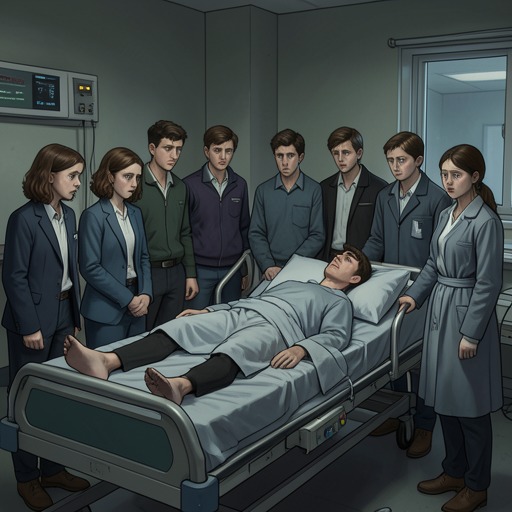
The consequences emerge starkly when Kimura and Wataru encounter four uniformed students in an alley. Two are holding another boy while the fourth faces them. The group discusses a plan to push the boy toward suicide without intending for him actually to die, and one student refers to a video already posted online. They also say that the Prince is furious. When Kimura connects the conversation to the earlier dispute about punishment, a student quietly tells him that Takuya is dead. The others’ shocked response indicates that they did not want this information disclosed to a stranger. The evidence links the Prince’s orders, the students’ bullying, and Takuya’s death in the same atmosphere of fear, but does not establish exactly how Takuya died.
The students’ position is not presented as innocence: they participate in harming classmates, yet their actions are also shaped by the expectation that refusal will bring punishment from above. The result is a chain in which fear passes downward. Instead of directing their anger toward the Prince, pupils monitor one another, dispute who has shown disloyalty, and try to avoid becoming the next person blamed.
Kimura’s account of learned helplessness
Kimura interprets the students’ apparent inability to resist through a memory from his former work. He recalls guarding a kidnapped man who was neither tied up nor locked in, yet did not leave. A fellow guard explained learned helplessness through an experiment in which a dog, after being shocked regardless of what it did, stopped trying to escape even when jumping could prevent a later shock. The explanation extended to people who come to believe that action cannot change their circumstances.
Kimura applies that idea cautiously to the school. The students have seen classmates and adults suffer at the Prince’s hands, and repeated experiences have persuaded them that they cannot defeat him. The electric shocks are likely part of what has deepened that conviction, though Kimura does not know how they are delivered or exactly what orders the Prince gives. His framework explains the students’ passivity as something learned under pressure, not proof that they are naturally submissive. He also recognizes their youth and vulnerability beneath their efforts to appear tough, but initially tells himself not to get involved.
Fear turned against potential allies
A later scene gives the school’s atmosphere a concrete shape. Kimura sees around ten students restraining Tomoyasu and his dog, Takeshi, with duct tape. The dog has been muzzled, and the students are preparing to use defibrillator pads. Their exchange reveals suspicion within the group: one threatens to report another to the Prince for having apologized while Tomoyasu was being beaten; the accused student denies it. Even a moment of sympathy is treated as potential evidence of disobedience.
Kimura recognizes the pattern from stories about Terahara’s criminal organization, where members distrusted one another and tried to ensure that someone else would bear the consequences of a mistake. At school, too, the Prince’s rule makes students watch their supposed allies and protect themselves from punishment. The scene does not establish what ultimately happens to Tomoyasu or Takeshi, but it shows the bullying’s wider effect: the Prince’s power is sustained not only by direct commands and threatened shocks, but by a breakdown of trust that makes collective resistance harder to imagine.